


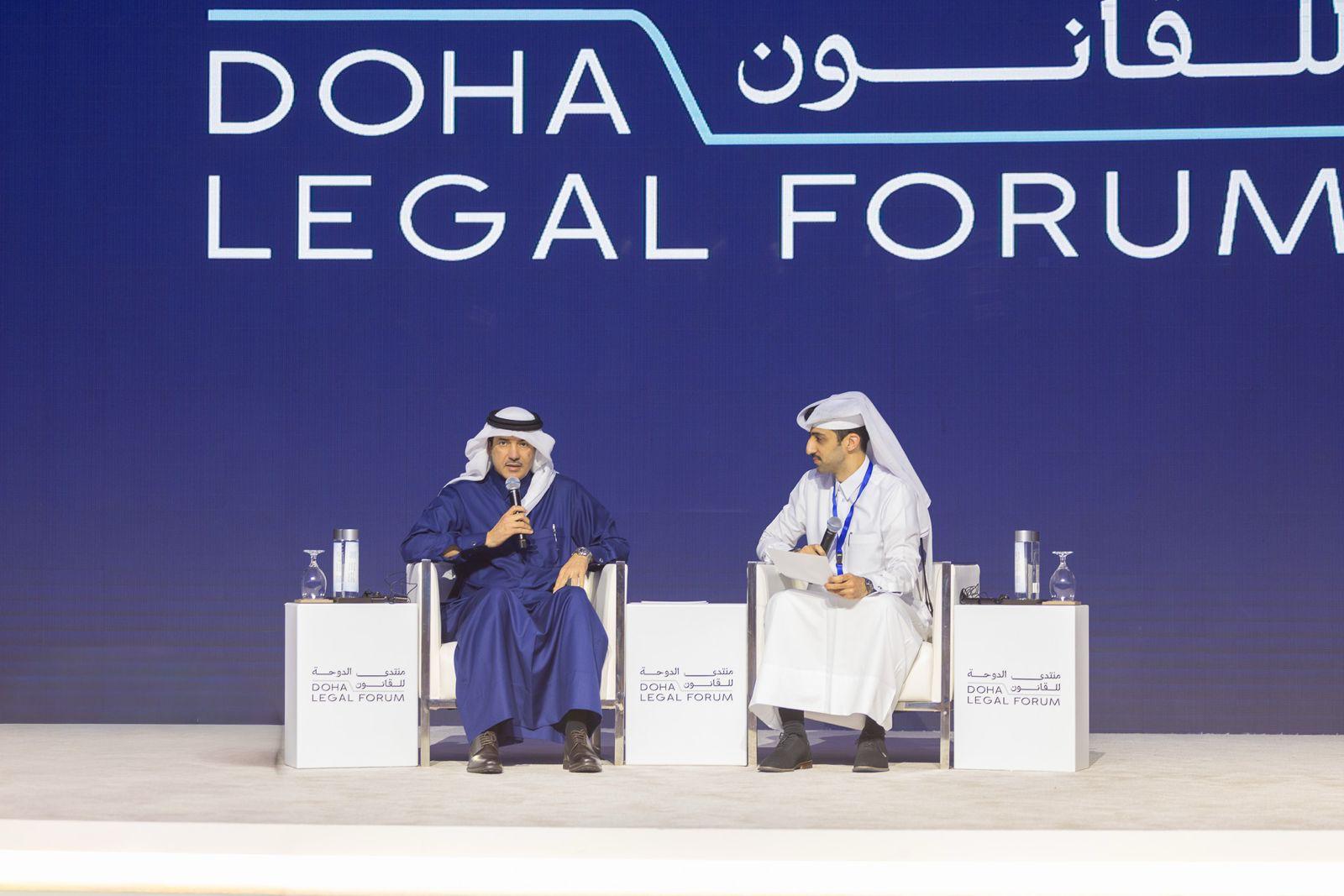
His Excellency Dr. Ahmed bin Mohammed Al Sayed, Minister of State for Foreign Trade, participated today, Tuesday, 27 January 2026, in a panel discussion held as part of the Doha Legal Forum, titled: “Towards a Flexible Regulatory Environment to Support Trade and Investment in the Era of the Digital Economy.”
During the session, His Excellency outlined the Ministry of Commerce and Industry’s vision for developing a flexible regulatory environment that keeps pace with the rapid transformations of the digital economy, contributing to the support of trade and investment, enhancing trust in digital transactions, and attracting high-quality investments in technology- and innovation-driven sectors.
He affirmed that the Ministry has achieved significant accomplishments in the field of foreign trade over recent years, most notably the signing of a large number of bilateral and multilateral agreements in the areas of trade and investment. In this context, the State of Qatar has concluded a total of 189 agreements with its trading partners, covering investment promotion and protection, economic, trade, and technical cooperation, the establishment of joint ministerial committees, as well as free trade agreements, thereby enhancing the openness of the national economy to global markets.
His Excellency noted that, within the framework of developing the foreign trade strategy, the Ministry is working on the preparation of a cooperation agreement on the digital economy, as well as a digital trade agreement with Qatar’s trading partners. This reflects the State’s orientation toward keeping pace with global transformations, strengthening its ability to attract high-quality investments in technology and innovation, and consolidating Qatar’s position as a modern global economic hub.
He added that the Ministry is also reviewing and updating existing trade and investment agreements to align with new-generation agreements, ensuring their compliance with the latest international standards and enhancing the national economy’s global competitiveness.
His Excellency explained that these initiatives have a direct positive impact on the private sector by providing a supportive legal and regulatory environment for the expansion of its activities globally, thereby strengthening the competitiveness of the national economy and reinforcing Qatar’s position as a leading investment destination.
He further addressed the role of foreign trade in enhancing the investment reputation of the State of Qatar as the country’s gateway to the world, supported by advanced world-class infrastructure that includes Hamad Port, Hamad International Airport, the free economic zones, the Qatar Financial Centre, and the Investment Qatar. These factors have strengthened Qatar’s position as a regional hub for trade and logistics services and increased investor confidence in the efficiency and flexibility of the business environment.
His Excellency also reviewed the impact of legislative policies on attracting investment, noting that within the Third National Development Strategy, the State of Qatar has set an ambitious target of attracting USD 100 billion in foreign direct investment by 2030. This is complemented by the launch of a USD 1 billion incentives program through Invest Qatar, along with the provision of competitive advantages that include full foreign ownership, tax exemptions, and specialized regulatory environments.
He emphasized that the international treaties and agreements concluded and acceded to by the State of Qatar have contributed to strengthening legal confidence among investors by providing transparent mechanisms for dispute resolution and protecting investments and intellectual property, which has become a fundamental pillar for supporting innovation and attracting investment to Qatar. These efforts enhance confidence in the national economy in line with the objectives of Qatar National Vision 2030, reflect alignment with global transformations, and further strengthen the State’s investment attractiveness.